
Alkagesta Joins Traders in Istanbul as Fertilizer Trade Flows Redraw
The trading house sent its fertilizer desk to the Argus Caspian, Black Sea and Eastern European markets conference, where redirected cargoes, carbon rules and Turkish hub ambitions dominated the agenda.
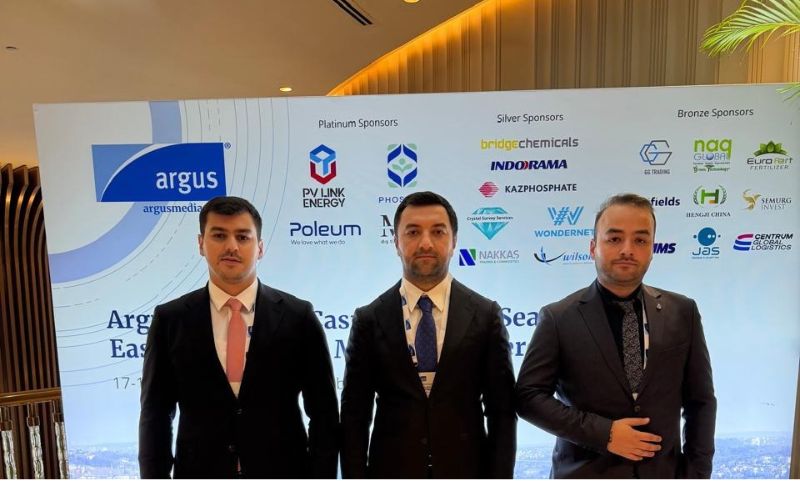
Fertilizer traders gathered in Istanbul on 17 and 18 September for the Argus Fertilizer Caspian, Black Sea and Eastern European Markets Conference 2026, and the mood reflected a market that has spent the year rerouting cargoes rather than simply repricing them. Organised by Argus Media, the event drew more than 450 attendees from over 250 companies across 45 countries, with emerging export markets and new cooperation strategies across the Caspian, Eastern Europe and Central Asia at the centre of the programme.
Among the trading houses present was Alkagesta, represented by fertilizer desk lead Vusal Muradov, fertilizer trader Tural Sabirzade and Mustafa Yigit Shen from the operations function. Over two days the team met producers, logistics providers and price reporting specialists — the practical network that decides whether a tonne booked on paper actually reaches a farmer.
Five themes shaped the discussion. The first was the outlook for the global fertilizer market, where pricing dynamics have become inseparable from supply chain disruption. The second was the Carbon Border Adjustment Mechanism, whose definitive phase places imported nitrogen products squarely inside Europe's carbon pricing perimeter and changes the competitive maths for anyone shipping into the bloc.
The third was Türkiye's growing role as a regional fertilizer hub, a function of geography as much as policy: the country sits between Black Sea and Caspian origins and the Mediterranean and North African demand centres. The fourth was Central Asian supply, where domestic demand and export ambition are increasingly pulling in different directions as regional producers look towards European buyers. The fifth was logistics — terminal capacity, corridor development and freight economics — which the International Fertilizer Association and other industry bodies have repeatedly flagged as the binding constraint on physical delivery.
That constraint is the backdrop to everything else. Disruption to key shipping corridors has exposed how thoroughly fertilizer supply chains were optimised for efficiency rather than resilience, and the recovery has been slower than the headlines that triggered it. Restoring physical flows is a process, not an event: vessels must be repositioned, berths rebooked and credit lines re-cut before a redirected cargo becomes a delivered one. The Food and Agriculture Organization has long tracked how quickly fertilizer affordability feeds into planting decisions, which is why trade desks watch freight and availability as closely as price.
Alkagesta's fertilizer desk trades nitrogen, phosphate and specialty products, sourcing from established global origins and matching those streams to markets where agricultural fundamentals are strongest — Europe, the Middle East, North Africa and a set of emerging agricultural markets where long-term supply partnerships, rather than spot opportunism, are the stated aim.
The Istanbul appearance also follows a wider push into price assessment. The company recently gained access to the Argus Open Markets window for European Biodiesel, HVO and UCO, extending its participation in Argus assessment processes beyond fertilizers into biofuels — a segment where IEA demand forecasts and European mandates are pulling volumes in the same direction.
Company coverage
Alkagesta
Alkagesta is a commodity trading company active in petroleum products, with a business built around fuel oil, gasoil and related refined products. Its activity spans physical supply, storage and the shipping arrangements required to move cargoes between refining centres and demand markets.
All Alkagesta coverage →Editorial Desk — Trade Flow Insight. Reporting and market notes compiled by the Trade Flow Insight editorial team.
Related coverage
SIBCON 2026: Singapore Builds Optionality Across Marine Fuel Pathways
At SIBCON 2026, Singapore set out a multi-fuel bunkering strategy spanning ammonia, LNG, bio-methane and ethanol, with record LNG bunker sales and the world's largest ethanol bunkering operation planned.
SIBCON 2026: MPA to Invite LNG Floating Storage Licence Applications by End-2026
Announced at SIBCON 2026, Singapore's plan to license LNG floating storage units follows the award of eight LNG bunker supplier licences in July and record LNG bunker sales of 571,400 tonnes in 2025.
SIBCON 2026: Singapore Charts a Resilient Multi-Fuel Future for Global Bunkering
The 24th Singapore International Bunkering Conference and Exhibition (SIBCON 2026), organised by the Maritime and Port Authority of Singapore, runs 13–15 October 2026 at Resorts World Sentosa under the theme "Charting a Resilient Multi-Fuel Future", with new standards for ammonia bunkering and digitalisation among the headline announcements.